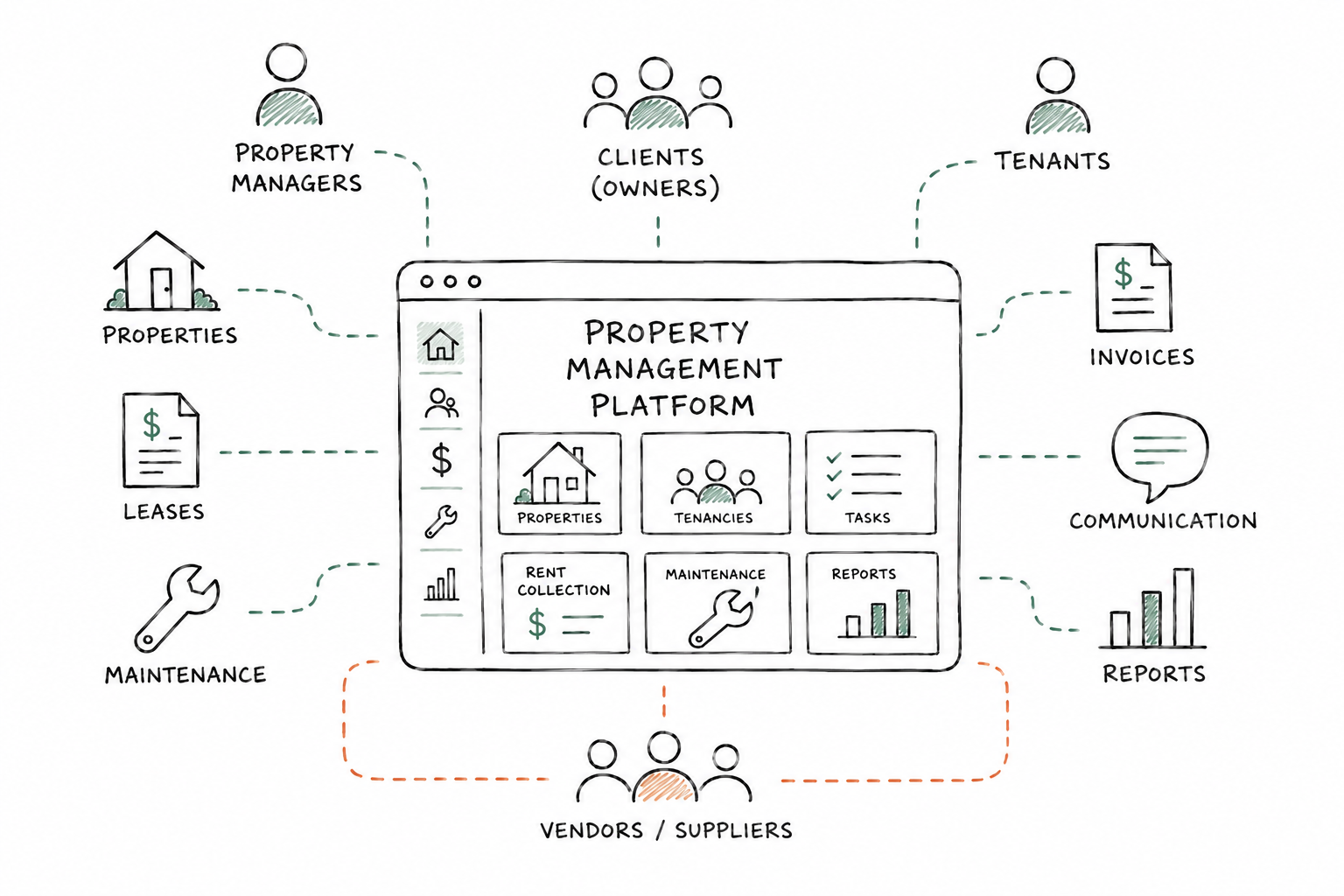

Property Management Platform
Building the software that connects day-to-day operations across property management, leasing, clients, tenants and vendors.
Overview
For more than a decade, I’ve developed and expanded a property management platform that supports the daily operations of a business managing more than 1,200 properties.
What began as an established internal application has evolved into a connected platform used by property managers, leasing staff, clients, tenants and external vendors — bringing operational data, workflows, communication and reporting into a shared system.
One Platform, Different Users
Property managers
Maintenance, inspections, invoicing, scheduling, property records and day-to-day operations.
Leasing staff
Vacancies, listings, rental applications, onboarding and lease creation.
Clients and property owners
Financial and inspection reports, property analytics, documents, tenant and lease information, onboarding workflows and maintenance approvals.
Tenants and vendors
Rental application, maintenance, communication and work-order workflows.
Turning Business Workflows into Software
One of the platform’s core systems is a work-order engine that tracks the complete lifecycle of a job — from identifying the work required and obtaining quotes through owner approval, vendor selection, execution, follow-up and invoicing.
Work orders can be created manually or automatically, and dashboards use status and follow-up dates to keep current and overdue work visible. The same system supports one-off maintenance issues, recurring reminders and larger renovation projects.
Client onboarding and rental applications moved from static forms to online workflows. Physical property files were replaced by digital documents, and financial reports that previously required staff involvement became available through the client portal.
Integrations & Automation
Common correspondence with clients, tenants and vendors became templated, automated or triggerable directly from operational events.
I developed an Outlook add-in that lets staff associate emails directly with properties. Email content and metadata are sent through a REST API and become searchable within the property management system rather than remaining isolated in individual inboxes.
Other integrations include Microsoft Graph, Zoho CRM synchronization, MLS data used for analytics, and GraphQL-based integrations supporting automated communication workflows.
Long-Term Platform Ownership
My role extends beyond implementing individual features. I work directly with nontechnical stakeholders to understand operational problems, evaluate options and trade-offs, design practical solutions, and carry them through implementation, deployment and production support.
That ownership includes production troubleshooting and root-cause analysis, ongoing modernization, evaluating build-versus-buy decisions, and balancing immediate business needs against long-term maintainability.
Security & Maintainability
The platform’s security has evolved alongside its functionality through modern authentication and authorization, role-based access controls, MFA, token-based access and protection of sensitive data.
Clearer application boundaries, SQL Server schema and query optimization, maintainable integration points, and practical framework upgrades make the system easier to troubleshoot and extend without losing the value of established workflows.
Outcome & Business Impact
The platform has become part of the operational backbone of the business, connecting property management, leasing, reporting, communication, inspections, maintenance and client services.
Its value comes from treating those capabilities as connected workflows rather than isolated features, and from continuously adapting the platform as the business identifies better ways to operate.
Technologies
Get in Touch.